
Private Home Record
This is a private overview of our technology assessment and modernization recommendation for your home. Please enter your access phrase to continue.
Need your phrase? Call us at (781) 333-8003.
This is a private overview of our technology assessment and modernization recommendation for your home. Please enter your access phrase to continue.
This goes beyond the room-by-room television and Sonos audio refresh on your main plan. It’s the complete path — retiring the entire Crestron and RTI control, the home network, and the whole-home audio & video distribution, replaced by one simpler, more reliable system.
A documented inventory of the existing three-bay rack — the cleanup, consolidation, and record-keeping your system has been missing. Identified from a full photographic survey; items still being confirmed are noted.
Two stacked control systems running one home.
RTI · CrestronA centralized video matrix routing every source to every TV.
MXNet AV-over-IPAn oversized Sonos system plus distributed-audio amplification.
Sonos · AudioControlWhole-home lighting and motorized shades on Crestron.
Crestron LightingThe backbone carrying AV, control, and the home network.
Luxul · LevitonLegacy phone system and the rack housing itself.
Panasonic · Middle Atlantic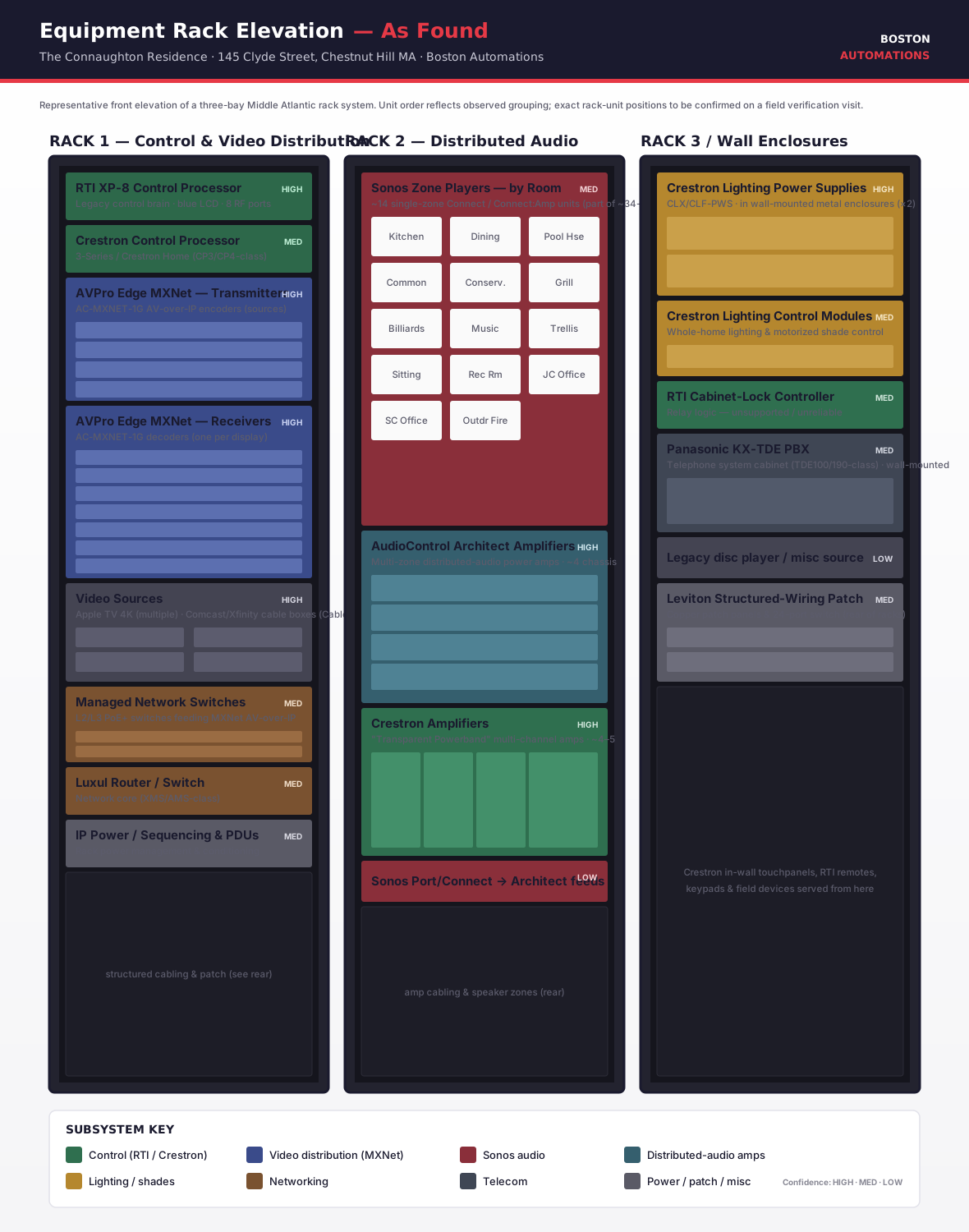
The hardware is largely premium and much of it still works. The problems are architectural, not cosmetic.
RTI and Crestron were layered over time. Two brains controlling one home doubles the failure points and the cost of every future change.
~34 single-zone Sonos players sit one-per-room — beyond Sonos' 32-device limit, and a textbook cause of the dropouts you experience.
The MXNet AV-over-IP matrix is powerful but the most complex, failure-prone part of the rack — and modern streaming makes most of it unnecessary.
The RTI relay-based lock logic is no longer reliable or supported — a clear candidate for a simple modern relay replacement.
Multiple TV generations and stacked cable boxes create inconsistent picture quality and HDMI signal instability.
Dense cabling and obsolete processors make the rack hard to service and impossible to hand off cleanly — which this assessment begins to fix.
Both retire the dual-control complexity and the oversized Sonos count. They differ mainly in how lighting, shades, and control are handled.
Keep the Crestron infrastructure — lighting, shades, and amplification — and migrate the whole home onto the modern Crestron Home OS. Retire RTI entirely.
Retire RTI and Crestron. Move lighting & shades to Lutron, standardize AV on Sonos audio and Apple TV 4K at every display, all on a dedicated AV network — Josh.ai-ready for natural voice control.
| Consideration | Path A — Crestron Home | Path B — Lutron / Sonos / Apple TV |
|---|---|---|
| Long-term reliability | Good — retains most complexity | Best — fewest points of failure |
| Ease of daily use | Good, app-based | Excellent, room-based + voice-ready |
| Lighting & shades | Reuse existing Crestron | New Lutron (gold standard) |
| Serviceability / hand-off | Dealer-programmed; truck-roll for changes | Standardized, largely self-serviceable |
| Up-front disruption | Lower | Higher (lighting/shade swap) |
| Ongoing support cost | Higher | Lower |
Path B at a glance. A detailed room-by-room equipment schedule and pricing are developed in the engineering phase.
Next step: a field verification visit to confirm the remaining items and capture exact rack positions, followed by the engineering phase — a room-by-room equipment schedule, final audio consolidation plan, and pricing, reviewed with you before any work begins.